Free Men in a Foreign Land
I thought I understood the value of my passport—a tangible proof of belonging.

This post was originally written by us in another language [here]. This English version was translated with Google Translate and lightly reviewed.
I thought I understood the value of my passport—a tangible proof of belonging.
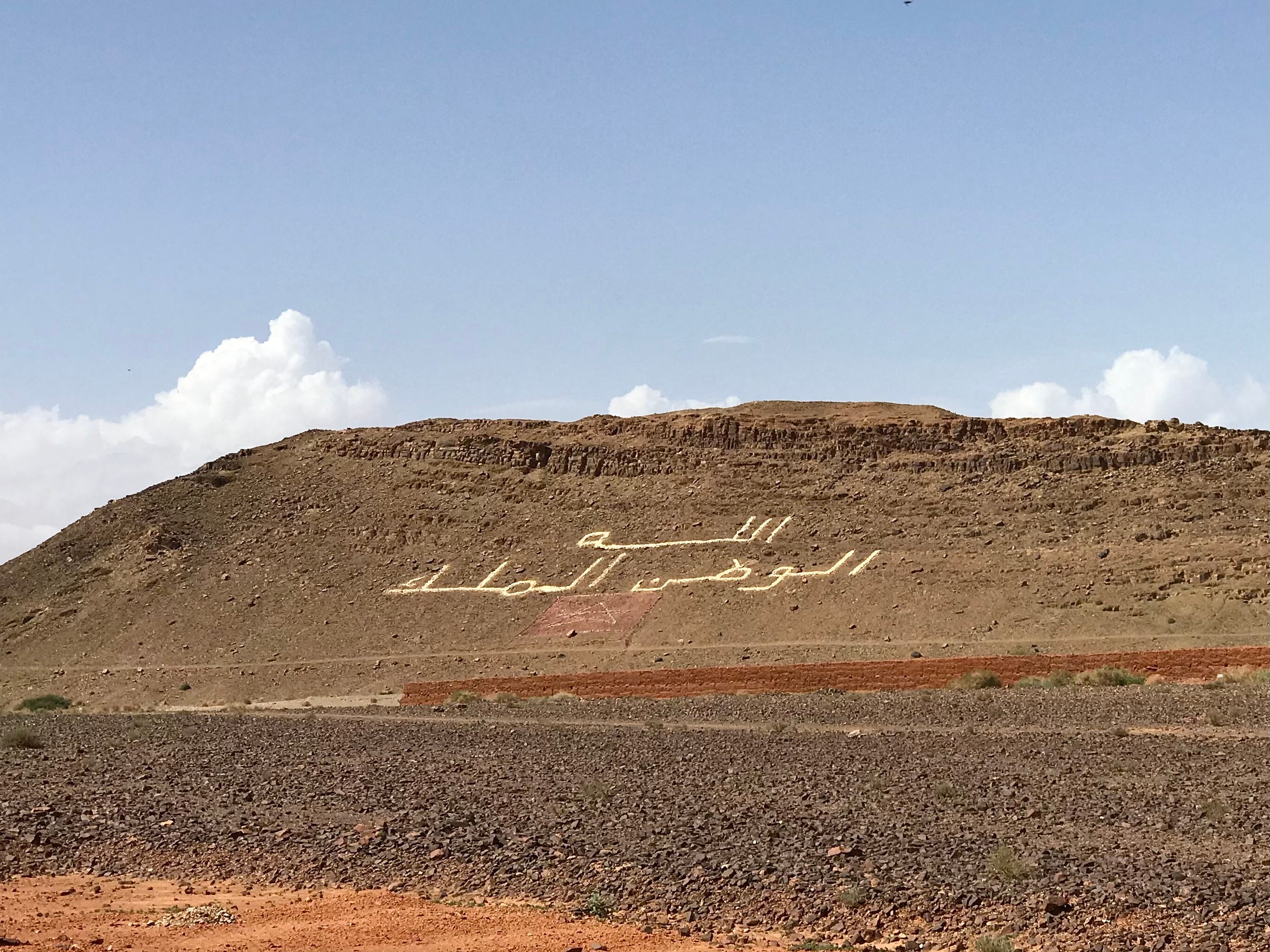
I was traveling to Merzouga when I saw the phrase inscribed on the mountain: *God, Country, King*. A motto presented as the nation’s fundamental truth, the order upon which everything else rests.
That was when I met an Amazigh man who showed me the crack in that order. His people—called Berbers by outsiders, but *Imazighen*—”free men”—by themselves—have a presence in Morocco that predates current borders, yet they have almost no share in the power that defines those borders.
He was not looking to flee; that was the first thing he made clear. His longing was for recognition: a space of dignity within the territory that belongs to him. He faces a State that has prioritized Arabization and the centralization of power at the expense of his ancestral identity.
His strategy is striking: to obtain a nationality other than his own—not to stay away, but to return with that foreign passport and truly live in his country.
The passport that allows me to enter Morocco is the very thing he needs as a shield. His local citizenship has become an anchor. State protection—the fundamental promise of the contract between individual and nation—is nonexistent. In its place: harshness, surveillance, and the possibility of selective justice.
A passport from a foreign sovereignty thus becomes the sole guardian of his freedom. His act is a silent critique: he is importing a diplomatic shield to force his own nation to treat him with the respect it has denied him as a citizen.
Having to become a foreigner to be a free man in one’s own land.
If, in our own homeland, security, justice, or access to power are skewed toward privilege, how far are we from needing our own “escape nationality” in order to make our voices heard? I have thought about it.
The motto on the mountain is the rhetoric of a State demanding loyalty. This man’s struggle is the darkness that allows that motto to be seen in its true scale.
The passport that allows us to enter other countries is, for him, the key to entering himself without fear.